


Camshaft Questions REVISED

Thread Starter
Mopar Fan
Joined: Feb 2013
Posts: 92
Likes: 1
From: Southeast, MI
Camshaft Questions REVISED
So you guys have given me AWESOME info on camshafts in my other thread! But a member on here caught something that I did not.
Here is the intended parts for the engine.
"Sunday cruiser and occasional car show. Has 727 trans with a 8 3/4 rear" 3.55" I am throwing a 4inch stroke down its throat with a .30 bore.
I DO want good idle, I do not plan on going over 5500 rpm. Unless provoked lol
I am putting on a RPM Performer intake "2 plane" on it. The plan is porting the J heads but I JUST found a deal on Craigslist today for some eddy heads that have the work done to them already.
9.7ish:1 compression, dished D cup forged pistons, pump gas...Mabye a 2500 stall."
Plan is to have power before 5500 RPM
~In the previous thread I guess I kinda snuck that 4 Inch stroke thing in there lol Sorry
@PK1 told me that with the stroke I am looking at, I should use a little higher duration with the longer stroke.
Thanks again guys!
~Sean
Here is the intended parts for the engine.
"Sunday cruiser and occasional car show. Has 727 trans with a 8 3/4 rear" 3.55" I am throwing a 4inch stroke down its throat with a .30 bore.
I DO want good idle, I do not plan on going over 5500 rpm. Unless provoked lol
I am putting on a RPM Performer intake "2 plane" on it. The plan is porting the J heads but I JUST found a deal on Craigslist today for some eddy heads that have the work done to them already.
9.7ish:1 compression, dished D cup forged pistons, pump gas...Mabye a 2500 stall."
Plan is to have power before 5500 RPM
~In the previous thread I guess I kinda snuck that 4 Inch stroke thing in there lol Sorry
@PK1 told me that with the stroke I am looking at, I should use a little higher duration with the longer stroke.
Thanks again guys!
~Sean

Mopar Fan
Joined: Mar 2013
Posts: 83
Likes: 11
From: Canada
Yep, Stroke eats up Camshaft duration quickly....what I mean here is a Cam that has a slight lope in a 318/340....
can be completely smooth in a 416 (4" Stroke .030 over 340 Block).
IMO,
DEFINATELY go for the Eddy's over the Ported J's, and adjust the Cylinder Pressure accordingly for the Aluminum vrs the Iron Heads
but,
do so....with careful final Camshaft selection events in mind.
No matter, plenty of good Cams available for the under 5500rpm target, the problem will be extending the 416's curve even with the eddy's on the Dual Plane Intake up TO the 5500 rpm.
Finalize the Heads to be used in the Combo prior to actual Camshaft selection.
can be completely smooth in a 416 (4" Stroke .030 over 340 Block).
IMO,
DEFINATELY go for the Eddy's over the Ported J's, and adjust the Cylinder Pressure accordingly for the Aluminum vrs the Iron Heads
but,
do so....with careful final Camshaft selection events in mind.
No matter, plenty of good Cams available for the under 5500rpm target, the problem will be extending the 416's curve even with the eddy's on the Dual Plane Intake up TO the 5500 rpm.
Finalize the Heads to be used in the Combo prior to actual Camshaft selection.
Mopar Lover
Joined: Jul 2011
Posts: 681
Likes: 106
Cant stress enough how CORRECT Mopar Bob was in his reply.
Ive done a couple of these and will do another in late spring.. I will try and document it in detail for the folks here but Im horrible with this internet stuff.
Pick a head first. Then you can dial in a rotating kit.. If I'm not mistaken you were going with a SCAT crank, I beams and a 9.6 forged slug in another post? ..I like the kit you selected. Used them and like them. And am going to use them again for a conservative build soon. But if you select the Eddys ( I recommend them) remember they are aluminum. Generally you want at least 1 full point of compression over a cast iron head build.
Then the camshaft.
Ive done a couple of these and will do another in late spring.. I will try and document it in detail for the folks here but Im horrible with this internet stuff.
Pick a head first. Then you can dial in a rotating kit.. If I'm not mistaken you were going with a SCAT crank, I beams and a 9.6 forged slug in another post? ..I like the kit you selected. Used them and like them. And am going to use them again for a conservative build soon. But if you select the Eddys ( I recommend them) remember they are aluminum. Generally you want at least 1 full point of compression over a cast iron head build.
Then the camshaft.
Thread Starter
Mopar Fan
Joined: Feb 2013
Posts: 92
Likes: 1
From: Southeast, MI
Thanks Moparbob and PK1 for the response.
I am going to be using the J heads as someone from the craigslist post already got to the heads before me
So cast iron it is!!
Why does the aluminum heads typically need 1 point higher on compression? Just curious.
@PK1, you are correct about the SCAT kit I am choosing. What camshaft would YOU run if you were in my place?? Thanks again
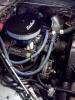
Here is what I got done tonight, started taking the carb off and just kept going till I cut my finger open lol Fun times in the garage

I am going to be using the J heads as someone from the craigslist post already got to the heads before me
So cast iron it is!!
Why does the aluminum heads typically need 1 point higher on compression? Just curious.
@PK1, you are correct about the SCAT kit I am choosing. What camshaft would YOU run if you were in my place?? Thanks again
Here is what I got done tonight, started taking the carb off and just kept going till I cut my finger open lol Fun times in the garage
Last edited by duster3; Mar 17, 2013 at 07:57 PM.
Mopar Fan
Joined: Mar 2013
Posts: 83
Likes: 11
From: Canada
For discussion, or a "better" understanding of describing the differences between an Aluminum vrs Iron Cylinder Heads characteristics in the combustion process..
I'm going to use an example.
If I were to simply say "Aluminum dissapates heat quicker", many would say "ok", but not really UNDERSTAND the concept ?
so, here goes
If I were to give Jethro a 3 foot piece of STEEL 3/8" redi-rod, tell him to hold onto just one "end" and hold it out towards me, while I heated the other end with a torch until RED HOT,
well,
Jethro could stand there holding on for probably 20 minutes before the heat from the end I was heating, would transfer down to the end he was holding and become too hot for him to hold.
Now,
If I were to give Jethro, another piece of Aluminum 3/8" redi-Rod, 3 foot long and said "hold one end", while I heated the other end with a Torch,
old jethro would be DROPPING that piece of Aluminum in about 30 seconds flat, because that heat would transfer down that 3 foot piece THAT FAST, and be too hot for him to hold !
Obviously,
the above is just for a very simplified descriptive purposes of a concept in thermal heat soak, and there is FAR MORE going on in the Combustion process..
nonetheless, you get the idea as it relates to things like Flamefront Propagation, Latent heat Soak Vrs Incipient Ignition, yada, yada, which gets waay too technical.
Long Story short,
Assuming, comparitive applications between Aluminum vrs Cast Iron Heads, related to Camshaft events, Fuel Quality, etc., etc., it is highly suggested to at least consider .5 minimum to .8, even 1 full point, Static Compression Ratio INCREASE when going to an Aluminum Head, from a Cast Iron Head application, to extract the same power output.(depending upon Camshaft & application..HP..Towing..Marine..etc)
PK1 hit the nail on the Head with the 1 full point as a great ballpark for a hotrod application.
Waaaay more goin on than we can get into here fella's, and I ain't here to get into any arguments, the above is pretty simplified, but YES, all things being equal, to maintain the same power, ADD Compression for the Aluminum Head.
Later fella's
I'm going to use an example.
If I were to simply say "Aluminum dissapates heat quicker", many would say "ok", but not really UNDERSTAND the concept ?
so, here goes
If I were to give Jethro a 3 foot piece of STEEL 3/8" redi-rod, tell him to hold onto just one "end" and hold it out towards me, while I heated the other end with a torch until RED HOT,
well,
Jethro could stand there holding on for probably 20 minutes before the heat from the end I was heating, would transfer down to the end he was holding and become too hot for him to hold.
Now,
If I were to give Jethro, another piece of Aluminum 3/8" redi-Rod, 3 foot long and said "hold one end", while I heated the other end with a Torch,
old jethro would be DROPPING that piece of Aluminum in about 30 seconds flat, because that heat would transfer down that 3 foot piece THAT FAST, and be too hot for him to hold !
Obviously,
the above is just for a very simplified descriptive purposes of a concept in thermal heat soak, and there is FAR MORE going on in the Combustion process..
nonetheless, you get the idea as it relates to things like Flamefront Propagation, Latent heat Soak Vrs Incipient Ignition, yada, yada, which gets waay too technical.
Long Story short,
Assuming, comparitive applications between Aluminum vrs Cast Iron Heads, related to Camshaft events, Fuel Quality, etc., etc., it is highly suggested to at least consider .5 minimum to .8, even 1 full point, Static Compression Ratio INCREASE when going to an Aluminum Head, from a Cast Iron Head application, to extract the same power output.(depending upon Camshaft & application..HP..Towing..Marine..etc)
PK1 hit the nail on the Head with the 1 full point as a great ballpark for a hotrod application.
Waaaay more goin on than we can get into here fella's, and I ain't here to get into any arguments, the above is pretty simplified, but YES, all things being equal, to maintain the same power, ADD Compression for the Aluminum Head.
Later fella's
Last edited by Moparbob; Mar 18, 2013 at 10:03 AM.
Mopar Lover
Joined: May 2012
Posts: 1,380
Likes: 103
From: Debary Florida

Thanks Moparbob and PK1 for the response.
I am going to be using the J heads as someone from the craigslist post already got to the heads before me
So cast iron it is!!
Why does the aluminum heads typically need 1 point higher on compression? Just curious.
@PK1, you are correct about the SCAT kit I am choosing. What camshaft would YOU run if you were in my place?? Thanks again
Here is what I got done tonight, started taking the carb off and just kept going till I cut my finger open lol Fun times in the garage

I am going to be using the J heads as someone from the craigslist post already got to the heads before me
So cast iron it is!!
Why does the aluminum heads typically need 1 point higher on compression? Just curious.
@PK1, you are correct about the SCAT kit I am choosing. What camshaft would YOU run if you were in my place?? Thanks again
Here is what I got done tonight, started taking the carb off and just kept going till I cut my finger open lol Fun times in the garage
the motor i pulled from my 86 5th was full of carbon and other baked on deposits that motor on emissions must have run 195+ in temp man it had carbon in her.
Who knows how the last owner took care of it
The motor you are talking about is a 318?
if so those eddy heads might have to large of valves in it for your 318 and the valve size dictates you chamfer the cylinders for them to clear.
so if your now with the stock cast iron heads you may not want to stuff the largest valves in them, you may sacrifice your low end power.
x-2 PK1, Moparbob.
Thread Starter
Mopar Fan
Joined: Feb 2013
Posts: 92
Likes: 1
From: Southeast, MI
@Moparbob,
Wow man, way more than I expected to get but the response is GREATLY appreciated!!I now have a better way of thinking about the engine.
@PK1,
I have the entire stock engine except the exhaust manifolds. I have the RPM performer intake as something I want to put on. I have a Carter carb. but I know that carb/RPM intake combo wont work.
I am thinking about the Edelbrock 800cfm Carb.
J heads are going to get a mild port job.
~I am unsure on hydraulic camshaft or not, I would like to convert to a hydraulic so I dont have to re adjust lash once a year but I dont know how/what I will need to convert the engine.
$300 for porting heads, $175 for valve job plus cost of parts..cut for seals costs extra, $160 for bore...
~Should I have the shop re-balance the kit I buy that already balanced??
This amount of money sounds kind of expensive to me, does this sound about right?
@Gorts,
Pretty darn close, its a 340 and it seemed to be well taken care of. The engine sat in the previous owners garage for a LONG time. Internals still had a nice thin coat of oil on them. Only bad part was the coolant passage had a little build up but to super bad!
Wow man, way more than I expected to get but the response is GREATLY appreciated!!I now have a better way of thinking about the engine.
@PK1,
I have the entire stock engine except the exhaust manifolds. I have the RPM performer intake as something I want to put on. I have a Carter carb. but I know that carb/RPM intake combo wont work.
I am thinking about the Edelbrock 800cfm Carb.
J heads are going to get a mild port job.
~I am unsure on hydraulic camshaft or not, I would like to convert to a hydraulic so I dont have to re adjust lash once a year but I dont know how/what I will need to convert the engine.
$300 for porting heads, $175 for valve job plus cost of parts..cut for seals costs extra, $160 for bore...
~Should I have the shop re-balance the kit I buy that already balanced??
This amount of money sounds kind of expensive to me, does this sound about right?
@Gorts,
Pretty darn close, its a 340 and it seemed to be well taken care of. The engine sat in the previous owners garage for a LONG time. Internals still had a nice thin coat of oil on them. Only bad part was the coolant passage had a little build up but to super bad!
Last edited by duster3; Mar 18, 2013 at 06:11 PM.

Mopar Lover
Joined: Jul 2011
Posts: 681
Likes: 106
Sorry this is long but I heading to the man cave for a night time tear down and it will be a late one..
I wouldn't spend 450 dollars on J heads unless it was a restoration. Yes, they are good heads. But they were never design for power you will be making. And even Eddys or RHS heads will be somewhat a restriction.
I would get a set of bare EQ heads from Competition Products ( 600 bucks pair) or what ever vendor you like. They flow 230 out of the box and use magnum rockers that you can get from the junk yard. Then add amc oil thru lifter and you are done. And have better oiling. The heads are already prepped for magnum 8mm valve and the magnum rockers are VERY strong. Add a 2.02 valve and you are at 247cfm without porting. Thats Eddy range. And the lower-mid lift numbers are better. Port them to 260-270 at home. Do some searching and read up on heads.
I would reuse your intake and carb.... I know, I know.. They are too small.. But you can change the intake and carb during a football game and the money will go a lot further on the heads. And you are going to have other unforeseen costs to get her rolling.
Your machine prices are cheap. I doubt they are using a plate to machine the bores. If they are for that price, awesome. If not make sure they alternate cylinders in a criss cross pattern when boring. The machinist needs the piston to cut the bores. If they say they don't, then walk away.
In my experience with machine shop or engine shops in general is to give them the money if they engage you and do good work. I would have them balance the assembly and spec you a bearing. So buy the bearing from them and the rings on your own. When you do this it causes them to check all the mains and then mic the crank. Thats piece of mind if you dont have the tools to measure. Then pastigauge to check when she is being assembled.
You didn't mention aligning the mains and if she was running and you checked bearings at diss assembly then your fine. BUT check clearances for sure.
You need to zero the deck to get your compression correct. Thats additional machining.
I wouldn't spend 450 dollars on J heads unless it was a restoration. Yes, they are good heads. But they were never design for power you will be making. And even Eddys or RHS heads will be somewhat a restriction.
I would get a set of bare EQ heads from Competition Products ( 600 bucks pair) or what ever vendor you like. They flow 230 out of the box and use magnum rockers that you can get from the junk yard. Then add amc oil thru lifter and you are done. And have better oiling. The heads are already prepped for magnum 8mm valve and the magnum rockers are VERY strong. Add a 2.02 valve and you are at 247cfm without porting. Thats Eddy range. And the lower-mid lift numbers are better. Port them to 260-270 at home. Do some searching and read up on heads.
I would reuse your intake and carb.... I know, I know.. They are too small.. But you can change the intake and carb during a football game and the money will go a lot further on the heads. And you are going to have other unforeseen costs to get her rolling.
Your machine prices are cheap. I doubt they are using a plate to machine the bores. If they are for that price, awesome. If not make sure they alternate cylinders in a criss cross pattern when boring. The machinist needs the piston to cut the bores. If they say they don't, then walk away.
In my experience with machine shop or engine shops in general is to give them the money if they engage you and do good work. I would have them balance the assembly and spec you a bearing. So buy the bearing from them and the rings on your own. When you do this it causes them to check all the mains and then mic the crank. Thats piece of mind if you dont have the tools to measure. Then pastigauge to check when she is being assembled.
You didn't mention aligning the mains and if she was running and you checked bearings at diss assembly then your fine. BUT check clearances for sure.
You need to zero the deck to get your compression correct. Thats additional machining.
Thread Starter
Mopar Fan
Joined: Feb 2013
Posts: 92
Likes: 1
From: Southeast, MI
TVLynn,
Yeah good call, Im getting ready to pull the timing chain and gears. Then down to the heads. Can I just check the diameter or the bore with my digital caliper or is there a better way to be more precise.
Yeah good call, Im getting ready to pull the timing chain and gears. Then down to the heads. Can I just check the diameter or the bore with my digital caliper or is there a better way to be more precise.
Thread Starter
Mopar Fan
Joined: Feb 2013
Posts: 92
Likes: 1
From: Southeast, MI
So I got down to the heads tonight and all went well!
Finished around 2a.m and I just keep getting more excited the farther I get into it.
The only downfall is I thought I had 2.02 J heads...I have 360 1.88 J heads, BUMMER
GOOD news is that its an uncut 340 block!
I am taking the heads in tomorrow to get checked out and then its onto the block...If the block checks out then I will buy the SCAT 416 stroker kit.
Thanks PK1 for the info about having the pistons BEFORE the block is bored, as I did not know that was necessary! Guess I am putting the shop to the test tomorrow and will let you guys know how it goes.
Thank you guys for putting up with all of these questions, I work very hard for my money and only want to do this once lol But I want to do it right!
How do you spec a bearing?? Or what is the differences between the manufacturers bearings that would change the spec?
Finished around 2a.m and I just keep getting more excited the farther I get into it.
The only downfall is I thought I had 2.02 J heads...I have 360 1.88 J heads, BUMMER
GOOD news is that its an uncut 340 block!
I am taking the heads in tomorrow to get checked out and then its onto the block...If the block checks out then I will buy the SCAT 416 stroker kit.
Thanks PK1 for the info about having the pistons BEFORE the block is bored, as I did not know that was necessary! Guess I am putting the shop to the test tomorrow and will let you guys know how it goes.
Thank you guys for putting up with all of these questions, I work very hard for my money and only want to do this once lol But I want to do it right!
How do you spec a bearing?? Or what is the differences between the manufacturers bearings that would change the spec?
Mopar Lover
Joined: Jul 2011
Posts: 681
Likes: 106
Sorry for using abbreviations . Spec= Specify.
The kit "assumes" the dimensions on your mains and provides you with a bearing that they hope gives you ".002-.0028 of clearance for conventional oil.
Since we have no idea of the "history" of that 340, it is money well spent to have the machine shop measure the mains on the unknown block and new crank to insure the bearing clearance you get at assembly gives you the proper clearance. The tools are expensive to do this at home. And from your posts I can tell your doing a lot of research for a reason.
Don't sweat the heads. If budget mandates you use them then just put her together and go. You'll have a rock solid short block and can upgrade when funds permit.
My recommendation is to NOT have the shop do springs for you until you get a cam. If you go with a Voodoo or XE or Hughes grind they need a little more spring pressure and you don't need to pay for two sets of springs. If you want them to set up the springs pull the trigger on a cam and take the springs in with you to the shop or tell them what pressures you need so they can get you set up right.
. Spec= Specify. The kit "assumes" the dimensions on your mains and provides you with a bearing that they hope gives you ".002-.0028 of clearance for conventional oil.
Since we have no idea of the "history" of that 340, it is money well spent to have the machine shop measure the mains on the unknown block and new crank to insure the bearing clearance you get at assembly gives you the proper clearance. The tools are expensive to do this at home. And from your posts I can tell your doing a lot of research for a reason.
Don't sweat the heads. If budget mandates you use them then just put her together and go. You'll have a rock solid short block and can upgrade when funds permit.
My recommendation is to NOT have the shop do springs for you until you get a cam. If you go with a Voodoo or XE or Hughes grind they need a little more spring pressure and you don't need to pay for two sets of springs. If you want them to set up the springs pull the trigger on a cam and take the springs in with you to the shop or tell them what pressures you need so they can get you set up right.


Mopar Lover
Joined: May 2011
Posts: 2,732
Likes: 361
From: Ontario Canada
Hey Duster, now would be the time to search out and consider block oiling improvements. Opening up the pump to filter and filter into block passages.
Have a look at your right galley feed to main bearing saddle passages too.
Some blocks are not fully drilled and step down in size. Don't worry about cross-over oiling if you find that, it's for 7000rpm engines.
http://www.forabodiesonly.com/mopar/...d.php?t=103623
Read through and take what you need many of the mods like cross-over with restrictors and tubing the lifter galleys are for regular 7-8000rpm use. The 9/32" is a must as I too have found small drilled holes to the main bearings. If you go 5/16" die grind the bearing saddle so the bit doesn't rattle around trying to start. Be careful and patient to prevent damage, it's not to hard to do.
Have a look at your right galley feed to main bearing saddle passages too.
Some blocks are not fully drilled and step down in size. Don't worry about cross-over oiling if you find that, it's for 7000rpm engines.
http://www.forabodiesonly.com/mopar/...d.php?t=103623
Read through and take what you need many of the mods like cross-over with restrictors and tubing the lifter galleys are for regular 7-8000rpm use. The 9/32" is a must as I too have found small drilled holes to the main bearings. If you go 5/16" die grind the bearing saddle so the bit doesn't rattle around trying to start. Be careful and patient to prevent damage, it's not to hard to do.
Last edited by Coronet 500; Mar 19, 2013 at 06:20 PM. Reason: Added from another post.
Thread Starter
Mopar Fan
Joined: Feb 2013
Posts: 92
Likes: 1
From: Southeast, MI
Thanks for all the posts!
So I just wrote this page long reply on here and lost power on my laptop...not happy lol
Anyways, I will be more brief this time around.
I found the same SCAT kit on rpmmachine.com without being balanced. ALMOST everyone I talked to said never just throw in the "pre-balanced" rotating assemblies. And its like an extra $185 on top of the kit.
*Now this may sound VERY dumb to some of you. But if I buy the kit with pistons and I dont get the rings with it, how do I determine what rings to buy..Are there different styles? Brands I need to use or not use?
I snagged a new engine stand from Habor Freight today for under $40. So now I can get to that crank without HE-MANNING the engine around lol
Sorry for all the dumb questions guys lol
@Coronet, I really never even thought about opening up anything in my block until you posted that. Thanks alot for that link!
Has anyone one tried opening up the oil passages like the link mentioned? I think I have all the tools to do this so thats pretty cool.
So I just wrote this page long reply on here and lost power on my laptop...not happy lol
Anyways, I will be more brief this time around.
I found the same SCAT kit on rpmmachine.com without being balanced. ALMOST everyone I talked to said never just throw in the "pre-balanced" rotating assemblies. And its like an extra $185 on top of the kit.
*Now this may sound VERY dumb to some of you. But if I buy the kit with pistons and I dont get the rings with it, how do I determine what rings to buy..Are there different styles? Brands I need to use or not use?
I snagged a new engine stand from Habor Freight today for under $40. So now I can get to that crank without HE-MANNING the engine around lol
Sorry for all the dumb questions guys lol
@Coronet, I really never even thought about opening up anything in my block until you posted that. Thanks alot for that link!
Has anyone one tried opening up the oil passages like the link mentioned? I think I have all the tools to do this so thats pretty cool.
Mopar Lover
Joined: May 2011
Posts: 2,732
Likes: 361
From: Ontario Canada
I do this to all of mine last one was my son's 318 Mag. You'll need 12 inch long drill bits, not too expensive and I can't remember the trade name for them but if you go to an industrial supplier they will know. Most important is get familiar with your oil system and the block off plug that is driven in through the oil pump passage. This should be taken out and new one installed by your machine shop.
POSITION OF THIS PLUG IS CRITICAL, and can be screwed up costing you bearings or extra work if you only find out when you prime your engine, like I've heard some have.
POSITION OF THIS PLUG IS CRITICAL, and can be screwed up costing you bearings or extra work if you only find out when you prime your engine, like I've heard some have.
Mopar Lover
Joined: Jul 2011
Posts: 681
Likes: 106
I recommended getting rings from the machine shop / engine builder because they are going to be a file fit. If you have a good parts store near you that's fine too. Don't let file fit scare you off.
Its actually a good exercise in detail work. You can do this your self with a hand wheel and a flat file. The rings require a specific gap once in the bore for expansion. So you need to take material off the ends to set them.
Moly rings are fine for your build.
If you get them from the builder / local shop you can go back if you grind one short. Oh, yes... I have ground them short. It happens and it is much easier to head to the local shop and grab one ring vs having them shipped from who knows where with a shipping charge for one ring.
Again, this is just my opinion as it worked logistically for me when I was learning.
Its actually a good exercise in detail work. You can do this your self with a hand wheel and a flat file. The rings require a specific gap once in the bore for expansion. So you need to take material off the ends to set them.
Moly rings are fine for your build.
If you get them from the builder / local shop you can go back if you grind one short. Oh, yes... I have ground them short.
It happens and it is much easier to head to the local shop and grab one ring vs having them shipped from who knows where with a shipping charge for one ring. Again, this is just my opinion as it worked logistically for me when I was learning.

Thread
Thread Starter
Forum
Replies
Last Post
staledog
General Technical Questions
11
May 19, 2009 08:29 PM


