


Idling problems


Thread Starter
Mopar Fanatic
Joined: Jun 2012
Posts: 377
Likes: 0
From: Medellin, Colombia
Idling problems
Hi everybody.
I need some help with the idling settings for my plymouth fury 1974. Some time ago I opened this post looking for help with my Holley 2245 carburetor, now I change it to a Carter AFB 625CFM. The car runs well but I have three issues:
1. When I crank the engine early in the morning is a bit difficult to start the car. I don't have to pump the throttle but I have to crank the engine between 3 or 4 times, is like while gasoline reaches the carburetor. If I replace the mechanical fuel pump to a electric fuel pump this will be resolved?
2. My second problem is that I think my idling RPM is a bit fast maybe 1000 RPM (sorry I don't have tachometer). I reach this conclusion because when I shift into drive position or reverse I can hear like if the transmission hits something. I tried to close a bit the idling speed crew and the engine sounded like it was at the right idling speed (750 RPM according to owners manual). But when I shift to drive position or reverse the engine stops even when I turn on the headlights the engine turns unstable and sometimes stops.
I already check if the carburetor has vacuum leaks and seems to have no vacuum leaks. I tune the carburetor again but the result is the same. So What can I try?
3. if I stop the car and I hit the throttle to the floor I can hear a backfire from the carburetor and sometimes the engine stops but If I make a smooth acceleration to the floor the backfire doesn't appear and the engine doesn't stops.
I want to notice that the carburetor already has a new tuning kit installed including new accelerator pump and the engine has a initial advance of 8 grades and the vacuum advance hose is plugged in
I need some help with the idling settings for my plymouth fury 1974. Some time ago I opened this post looking for help with my Holley 2245 carburetor, now I change it to a Carter AFB 625CFM. The car runs well but I have three issues:
1. When I crank the engine early in the morning is a bit difficult to start the car. I don't have to pump the throttle but I have to crank the engine between 3 or 4 times, is like while gasoline reaches the carburetor. If I replace the mechanical fuel pump to a electric fuel pump this will be resolved?
2. My second problem is that I think my idling RPM is a bit fast maybe 1000 RPM (sorry I don't have tachometer). I reach this conclusion because when I shift into drive position or reverse I can hear like if the transmission hits something. I tried to close a bit the idling speed crew and the engine sounded like it was at the right idling speed (750 RPM according to owners manual). But when I shift to drive position or reverse the engine stops even when I turn on the headlights the engine turns unstable and sometimes stops.
I already check if the carburetor has vacuum leaks and seems to have no vacuum leaks. I tune the carburetor again but the result is the same. So What can I try?
3. if I stop the car and I hit the throttle to the floor I can hear a backfire from the carburetor and sometimes the engine stops but If I make a smooth acceleration to the floor the backfire doesn't appear and the engine doesn't stops.
I want to notice that the carburetor already has a new tuning kit installed including new accelerator pump and the engine has a initial advance of 8 grades and the vacuum advance hose is plugged in
Last edited by josehf34; Dec 8, 2013 at 01:36 PM.

Mopar Lover
Joined: Nov 2007
Posts: 2,424
Likes: 248
There are so many things this could be, that really, you should find a local "old guy" who knows something about older cars and systems.
1...General tune up. Who knows what condition the engine is in, perform a compression test, leak down test, cylinder balance test. Inspect, replace necessary components of the ignition system, including plugs, wires, cap, rotor, points if used, and inspect other components
2---Timing. "Sticker" timing IE emissions sticker was for EMISSIONS and not driveability, power or mileage. In addtion, who knows what distributor has been swapped in after all these years?
Distributor advance mechanism could be stuck, vacuum advance could be ruptured. Generally, you want more initial advance that "the smog" specifies. You could bump it up "a few" degrees but you must be careful it does not over--advance at the top end
SHORTER ADVANCE CURVE AND MORE INITIAL (idle) advance helps low speed power and torque
3...Carb condition and adjustment. A vacuum leak or other too--lean condition will cause what you describe. Repair accordingly. Carb idle mixture MUST be "end adjusted" with engine fully warmed, and AT the proper curb idle speed.
4...Poor electrical condition. Many of these cars are developing bad electrical connections. Most problematic other than "all connections" is the bulkhead connector, ignition switch connector, and the switch itself.
1...General tune up. Who knows what condition the engine is in, perform a compression test, leak down test, cylinder balance test. Inspect, replace necessary components of the ignition system, including plugs, wires, cap, rotor, points if used, and inspect other components
2---Timing. "Sticker" timing IE emissions sticker was for EMISSIONS and not driveability, power or mileage. In addtion, who knows what distributor has been swapped in after all these years?
Distributor advance mechanism could be stuck, vacuum advance could be ruptured. Generally, you want more initial advance that "the smog" specifies. You could bump it up "a few" degrees but you must be careful it does not over--advance at the top end
SHORTER ADVANCE CURVE AND MORE INITIAL (idle) advance helps low speed power and torque
3...Carb condition and adjustment. A vacuum leak or other too--lean condition will cause what you describe. Repair accordingly. Carb idle mixture MUST be "end adjusted" with engine fully warmed, and AT the proper curb idle speed.
4...Poor electrical condition. Many of these cars are developing bad electrical connections. Most problematic other than "all connections" is the bulkhead connector, ignition switch connector, and the switch itself.
Thread Starter
Mopar Fanatic
Joined: Jun 2012
Posts: 377
Likes: 0
From: Medellin, Colombia
There are so many things this could be, that really, you should find a local "old guy" who knows something about older cars and systems.
1...General tune up. Who knows what condition the engine is in, perform a compression test, leak down test, cylinder balance test. Inspect, replace necessary components of the ignition system, including plugs, wires, cap, rotor, points if used, and inspect other components
2---Timing. "Sticker" timing IE emissions sticker was for EMISSIONS and not driveability, power or mileage. In addtion, who knows what distributor has been swapped in after all these years?
Distributor advance mechanism could be stuck, vacuum advance could be ruptured. Generally, you want more initial advance that "the smog" specifies. You could bump it up "a few" degrees but you must be careful it does not over--advance at the top end
SHORTER ADVANCE CURVE AND MORE INITIAL (idle) advance helps low speed power and torque
3...Carb condition and adjustment. A vacuum leak or other too--lean condition will cause what you describe. Repair accordingly. Carb idle mixture MUST be "end adjusted" with engine fully warmed, and AT the proper curb idle speed.
4...Poor electrical condition. Many of these cars are developing bad electrical connections. Most problematic other than "all connections" is the bulkhead connector, ignition switch connector, and the switch itself.
1...General tune up. Who knows what condition the engine is in, perform a compression test, leak down test, cylinder balance test. Inspect, replace necessary components of the ignition system, including plugs, wires, cap, rotor, points if used, and inspect other components
2---Timing. "Sticker" timing IE emissions sticker was for EMISSIONS and not driveability, power or mileage. In addtion, who knows what distributor has been swapped in after all these years?
Distributor advance mechanism could be stuck, vacuum advance could be ruptured. Generally, you want more initial advance that "the smog" specifies. You could bump it up "a few" degrees but you must be careful it does not over--advance at the top end
SHORTER ADVANCE CURVE AND MORE INITIAL (idle) advance helps low speed power and torque
3...Carb condition and adjustment. A vacuum leak or other too--lean condition will cause what you describe. Repair accordingly. Carb idle mixture MUST be "end adjusted" with engine fully warmed, and AT the proper curb idle speed.
4...Poor electrical condition. Many of these cars are developing bad electrical connections. Most problematic other than "all connections" is the bulkhead connector, ignition switch connector, and the switch itself.
1. The engine compression and general shape is good, the engine was rebuilt some time ago and currently only has 98 miles, the block where bored 0.020" over. I found an old guy a time ago, he did the carburetor swap and teach me how to find vacuum leaks and how to adjust the idle mixture screws. He did the first carburetor tuning but I tune it again due to this problem but nothing change
2. When I swapped the distributor the car had the stock from factory, now the car has one of this distributors. So isn't a problem if the idle speed is over 750 RPM ?
3. The carburetor has been rebuilt a week ago. All the gaskets, meetering rods, jets, accelerator pump and other things where replaced and I already check if the carburetor has vacuum leaks but seems to it doesn't has vacuum leaks
4. I changed the ignition coil to a Mallory 58000 V and the spark plug wires was replaced with this MSD wires
EDIT: Sorry I miss a big detail. I only notice that the idle speed is fast when I shift into neutral or parking position. If I shift into reverse or drive position the idling speed seems to be normal. I don't know if this could help to get a diagnostic
Last edited by josehf34; Dec 8, 2013 at 07:29 PM.

Mopar Lover
Joined: Apr 2012
Posts: 694
Likes: 59
From: NH
Yes, your idle in neutral and park will be higher. Newer cars with fuel injection have air injection solenoids and whatnot, and therefore a consistent idle in park or drive. I agree with 440roadrunner above, bump the initial timing 2-3 degrees and see if that helps.

Mopar Lover
Joined: Nov 2012
Posts: 1,846
Likes: 140
to adjust idle mixture screws on a AFB. 1. most mild engines idle 600-700 RPM, to adjust the screws drop the RPM to 450-500. 2. a tach, or ext pipe sniffer. my dad only used his ear for hearing smoothness more than RPM. 3. turn each idle mix screw separate. 4. turn each one 1/4 turn at a time. 5. do one screw then the other, if it needs more than 1/4 do so. 6 when you are done raise RPM to driving RPM. 7 check the screws again, they may need s a small amount of change at the driving RPM. if they need a lot something is off. 8.. when done the engine should turn offwith out chugging. 9. now slowly cover the air horn with hand. if the RPM goes up, that means the idle circuit is lean. the fix for that is to drill the idle tube. that is NOT for most people. DO NOT try that unless someone that really knows how has shown you. if its a pre 1968 that should NOT happen.
Mopar Lover
Joined: Nov 2007
Posts: 2,424
Likes: 248
I don't know a thing about that distributor you installed, can you find anything that shows what the advance curve is?
Having the carb rebuilt really means nothing, unless it has been properly adjusted, and "adjusts properly." What I mean by that is that the idle mixture has been properly adjusted, and someone doing so who knows what to expect can get a fair idea that the idle mixture "has control" and that they are "acting normally."
Each screw should drop the idle speed when turned in (lean) and turned too far out (rich). As posted above, best way to set 'em is with a tach or vacuum gauge.
The idle mixture settings and initial timing can have a profound affect on "how a car runs" at idle and "just off throttle," those two things all by themselves.
Having the carb rebuilt really means nothing, unless it has been properly adjusted, and "adjusts properly." What I mean by that is that the idle mixture has been properly adjusted, and someone doing so who knows what to expect can get a fair idea that the idle mixture "has control" and that they are "acting normally."
Each screw should drop the idle speed when turned in (lean) and turned too far out (rich). As posted above, best way to set 'em is with a tach or vacuum gauge.
The idle mixture settings and initial timing can have a profound affect on "how a car runs" at idle and "just off throttle," those two things all by themselves.
Thread Starter
Mopar Fanatic
Joined: Jun 2012
Posts: 377
Likes: 0
From: Medellin, Colombia
Yes, your idle in neutral and park will be higher. Newer cars with fuel injection have air injection solenoids and whatnot, and therefore a consistent idle in park or drive. I agree with 440roadrunner above, bump the initial timing 2-3 degrees and see if that helps.
to adjust idle mixture screws on a AFB. 1. most mild engines idle 600-700 RPM, to adjust the screws drop the RPM to 450-500. 2. a tach, or ext pipe sniffer. my dad only used his ear for hearing smoothness more than RPM. 3. turn each idle mix screw separate. 4. turn each one 1/4 turn at a time. 5. do one screw then the other, if it needs more than 1/4 do so. 6 when you are done raise RPM to driving RPM. 7 check the screws again, they may need s a small amount of change at the driving RPM. if they need a lot something is off. 8.. when done the engine should turn offwith out chugging. 9. now slowly cover the air horn with hand. if the RPM goes up, that means the idle circuit is lean. the fix for that is to drill the idle tube. that is NOT for most people. DO NOT try that unless someone that really knows how has shown you. if its a pre 1968 that should NOT happen.
1. Close both mixture screws (clockwise) and then open both 2 turns or 2.5 turns.
2. Start the engine (transmission in neutral position).
3. turn the idle speed crew clockwise to raise up a bit the idling speed. Then shift to drive position with headlights and A/C Compressor working.
4. At this point the idling speed must be a bit unstable then I close 1/4 turn clockwise the idle speed crew.
5. I had to close the right mixture screw to the point in which the engine start dying, then open it to to the point in which the engine turn unstable, then I start to close the crew to the point when the engine sounds more happier
6. Repeat the step number five with the left mixture crew
7. Try to open 1/8 the idle speed crew
Last edited by josehf34; Dec 9, 2013 at 10:45 AM.
Mopar Lover
Joined: Nov 2012
Posts: 1,846
Likes: 140
best to adjust the mix screws in park. if the screws are adj right it will when put in gear the RPM will not drop much, or the smoothness change much. your idea if adjusting should work fine. the most important thing is smooth running, in and out of gear.

Mopar Fan
Joined: Feb 2013
Posts: 76
Likes: 2
go by a vacum gauge,timing light and if you can a Sears/Craftsman engine analyzer like the Sunpro Actron CP7605 Dwell/Tachometer/Voltmeter Analyzer its about 40 bucks roughly.
Thread Starter
Mopar Fanatic
Joined: Jun 2012
Posts: 377
Likes: 0
From: Medellin, Colombia
Some minutes ago I was trying to tune the carburetor again but I couldn't succeed but I noticed that If I close all the right mixture screw the engine dies but If I close all the left mixture screw the engine turns unstable but don't dies so I think the idle circuit is dirty  tomorrow I'm going to buy some carburetor cleaner fluid to check again if I have some vacuum leaks and to clean the idle circuit. Will this be enought or must I use compressed air?
tomorrow I'm going to buy some carburetor cleaner fluid to check again if I have some vacuum leaks and to clean the idle circuit. Will this be enought or must I use compressed air?
Thread Starter
Mopar Fanatic
Joined: Jun 2012
Posts: 377
Likes: 0
From: Medellin, Colombia
Today I finished the entire carb cleaning and I changed again the accelerator pump, check ball and all the gaskets but the problem continues. The engine now idles smoother but now I don't get backfire if I put the throttle to the floor the car just stops and the idling problem continues if I turn the A/C compressor on, put the headlights on or just shift to reverse or drive the engine stops.
Maybee I need a better tuning? maybe change jets size or metering rods?
Maybee I need a better tuning? maybe change jets size or metering rods?
Mopar Lover
Joined: Nov 2012
Posts: 1,846
Likes: 140
on AFBs only change a jet OR a rod. NEVER change both at the same time. if you change both at the same time you wont be able to tell what your change is. its best to change the rods first. the rods on O.E.M. AFB have a smaller steps than eddycrock carbs. and that is what you need. unless its a full out race engine.
Thread Starter
Mopar Fanatic
Joined: Jun 2012
Posts: 377
Likes: 0
From: Medellin, Colombia
on AFBs only change a jet OR a rod. NEVER change both at the same time. if you change both at the same time you wont be able to tell what your change is. its best to change the rods first. the rodable s on O.E.M. AFB have a smaller steps than eddycrock carbs. and that is what you need. unless its a full out race engine.
Thread Starter
Mopar Fanatic
Joined: Jun 2012
Posts: 377
Likes: 0
From: Medellin, Colombia
I was thinking about my problems related with headlights and engine rpm and I remember something: When the mechanic was installing the new HEI Distributor he said to me that had some troubles looking for a constant power supply and I know that HEI distributor could be a headache if it doesn't get a constant 12V source so I start to think that my carburetor is ok and the problem could be distributor.
Im going to verify if the distributor is getting 12V but if it doesnt, what wire could be a good 12V source?
Im going to verify if the distributor is getting 12V but if it doesnt, what wire could be a good 12V source?
Last edited by josehf34; Dec 16, 2013 at 11:11 AM.

Thread Starter
Mopar Fanatic
Joined: Jun 2012
Posts: 377
Likes: 0
From: Medellin, Colombia
My AFB is a 9605S, I think is a mopar carburetor
Last edited by josehf34; Dec 16, 2013 at 11:52 AM.
Mopar Lover
Joined: Nov 2007
Posts: 2,424
Likes: 248
12V and charging voltage, (14) are often used interchangeably. HEI based systems do not use a coil ballast resistor as the Mopars did, either points or electronic. Basically, you bypass the resistor, and use the original coil + wire to supply the HEI
HERE'S the deal.......
There is ONLY ONE switched ignition source under the hood. This comes from a switch contact in the ignition switch, goes through the bulkhead connector, and (in 69/ earlier) feeds the coil resistor and voltage regulator. This wire was traditionally dark blue
In 70/ later, in addition to above, this wire also feeds the alternator field (blue), electric choke if used, and in some cars, some "smog doo dads"
IT IS IMPORTANT to understand that when the key is twisted to "start" THIS SOURCE which is what Ma calls "IGN 1" goes DEAD.
THE ONLY source of ignition voltage during "start" is originally supplied by a special, seperate contact in the ignition switch, which goes through the bulkhead, and goes to the coil+ side of the original ballast resistor. Ma called this "IGN2", traditionally brown
THIS WIRE when using HEI, MUST be connected to the "ignition run" wire
My only manual for '74 is paper. If I get time I'll post part of the diagram. This is difficult in 74 because of the way the diagrams are drawn. If you do not have a FACTORY shop manual, you need to GET one. There are two...........chassis and body.
HERE'S the deal.......
There is ONLY ONE switched ignition source under the hood. This comes from a switch contact in the ignition switch, goes through the bulkhead connector, and (in 69/ earlier) feeds the coil resistor and voltage regulator. This wire was traditionally dark blue
In 70/ later, in addition to above, this wire also feeds the alternator field (blue), electric choke if used, and in some cars, some "smog doo dads"
IT IS IMPORTANT to understand that when the key is twisted to "start" THIS SOURCE which is what Ma calls "IGN 1" goes DEAD.
THE ONLY source of ignition voltage during "start" is originally supplied by a special, seperate contact in the ignition switch, which goes through the bulkhead, and goes to the coil+ side of the original ballast resistor. Ma called this "IGN2", traditionally brown
THIS WIRE when using HEI, MUST be connected to the "ignition run" wire
My only manual for '74 is paper. If I get time I'll post part of the diagram. This is difficult in 74 because of the way the diagrams are drawn. If you do not have a FACTORY shop manual, you need to GET one. There are two...........chassis and body.
Thread Starter
Mopar Fanatic
Joined: Jun 2012
Posts: 377
Likes: 0
From: Medellin, Colombia
Some minutes ago I checked what voltage is coming in the ignition coil and I went very surprised, my tester indicates that I only have 1.57V instead of 12V at the ignition coil terminals with the engine running (I don't have idea about how the engine can start with this disaster) so I'm pretty sure that this is the cause of my headache
In the attachments are some photos of this disaster. If I'm right and according to Mr 440roadrunner the ballast resistor must be unplugged.
Maybe tomorrow I'm going to repeat the wiring work but I want to be pretty sure about what I'm going to do. What I understood is that I must disconnect everything from the ballast resistor and must Unplug the ignition module terminal, instead of all this wiring I must connect the + terminal of the distributor to the + terminal in the ignition coil but I don't know where to connect this + terminal because If I connect it to the battery this maybe will drain the battery when the engine is stopped.
In this moment near the distributor are some wires unplugged but Which is the ignition run wire? what is the color? How must I connect the ignition run wire and the start wire ? Where goes the negative of the distributor and coil?
I found this and this wiring diagram, could this help?
Edit: Can the Dizzy connector help to do the wiring? it actually is unplugged
In the attachments are some photos of this disaster. If I'm right and according to Mr 440roadrunner the ballast resistor must be unplugged.
Maybe tomorrow I'm going to repeat the wiring work but I want to be pretty sure about what I'm going to do. What I understood is that I must disconnect everything from the ballast resistor and must Unplug the ignition module terminal, instead of all this wiring I must connect the + terminal of the distributor to the + terminal in the ignition coil but I don't know where to connect this + terminal because If I connect it to the battery this maybe will drain the battery when the engine is stopped.
In this moment near the distributor are some wires unplugged but Which is the ignition run wire? what is the color? How must I connect the ignition run wire and the start wire ? Where goes the negative of the distributor and coil?
I found this and this wiring diagram, could this help?
Edit: Can the Dizzy connector help to do the wiring? it actually is unplugged
Last edited by josehf34; Dec 17, 2013 at 06:53 AM.
Thread Starter
Mopar Fanatic
Joined: Jun 2012
Posts: 377
Likes: 0
From: Medellin, Colombia
Hi Guys I already did some changes to the wiring and now the car idles smoother but the voltage ignition coil problems continues. If I check the voltage in some part I get 11.57 V with engine running but If I check the voltage in the ignition coil with the engine running I get between 3.5V and 4.7V (If I rev the engine this voltage goes up to 5.7V). Here's a picture:
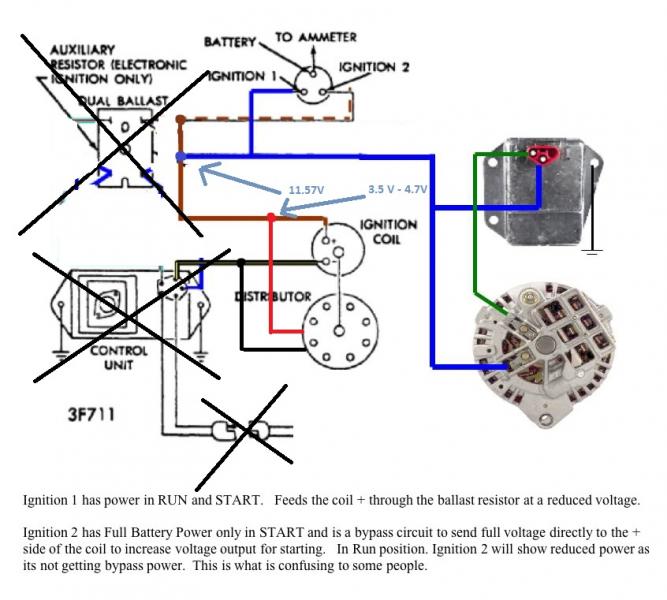
I tried to connect the battery to the ignition coil but I don't get power, then I check ignition coil voltage connected to the battery and there's only 0.02V so I thing I have ground problems. What do the experts recommend?
PD: I have a black-yellow wire near to the distributor, this wire always has 12V - 13V but only has power when the factory ignition module is connected, according to the car wiring diagram this is the original ignition coil wire ground. Could I use this for something?
EDIT: Now I have the + side of ignition coil connected to the battery, the car runs awesome but I need to do well the connection because in this moment if I turn off the switch the car doesn't stop, I must disconnect de battery but If I check the ignition coil voltage with the voltimeter it still showing 4V but If I put the negative side of the voltimeter on the engine block It shows 12.7V so I think the problem is the ground because the negative side of the coil is connected to the negative side of the distributor. Must I connect the negative to other part? maybe the negative side of battery?
I tried to connect the battery to the ignition coil but I don't get power, then I check ignition coil voltage connected to the battery and there's only 0.02V so I thing I have ground problems. What do the experts recommend?
PD: I have a black-yellow wire near to the distributor, this wire always has 12V - 13V but only has power when the factory ignition module is connected, according to the car wiring diagram this is the original ignition coil wire ground. Could I use this for something?
EDIT: Now I have the + side of ignition coil connected to the battery, the car runs awesome but I need to do well the connection because in this moment if I turn off the switch the car doesn't stop, I must disconnect de battery but If I check the ignition coil voltage with the voltimeter it still showing 4V but If I put the negative side of the voltimeter on the engine block It shows 12.7V so I think the problem is the ground because the negative side of the coil is connected to the negative side of the distributor. Must I connect the negative to other part? maybe the negative side of battery?
Last edited by josehf34; Dec 22, 2013 at 02:43 PM.

Thread Starter
Mopar Fanatic
Joined: Jun 2012
Posts: 377
Likes: 0
From: Medellin, Colombia
Hi everybody
Finally I made a relay system to avoid the electrical problems, now the car runs very smooth, has a very easy cold start (one or two cranks and is done) and the fast idle problems are gone. Here's a picture about what I did:

The only problem that still continues is when I'm at a dead stop and I hit the throttle to the floor, the car still making a backfire, I tried to adjust the accelerator pump but has no change. What can be wrong? Maybe is time to change jets?
I think I must change the kick down and throttle linkage. My mechanic did an adaptation to the actual throttle and kickdown linkage but sometimes causes discomfort in the throttle. I want to change the kickdown linkage with a Lockar kickdown cable but What could be a good replacement for the throttle linkage?
Finally I made a relay system to avoid the electrical problems, now the car runs very smooth, has a very easy cold start (one or two cranks and is done) and the fast idle problems are gone. Here's a picture about what I did:
The only problem that still continues is when I'm at a dead stop and I hit the throttle to the floor, the car still making a backfire, I tried to adjust the accelerator pump but has no change. What can be wrong? Maybe is time to change jets?
I think I must change the kick down and throttle linkage. My mechanic did an adaptation to the actual throttle and kickdown linkage but sometimes causes discomfort in the throttle. I want to change the kickdown linkage with a Lockar kickdown cable but What could be a good replacement for the throttle linkage?
Last edited by josehf34; Dec 25, 2013 at 01:42 PM.

Thread
Thread Starter
Forum
Replies
Last Post


